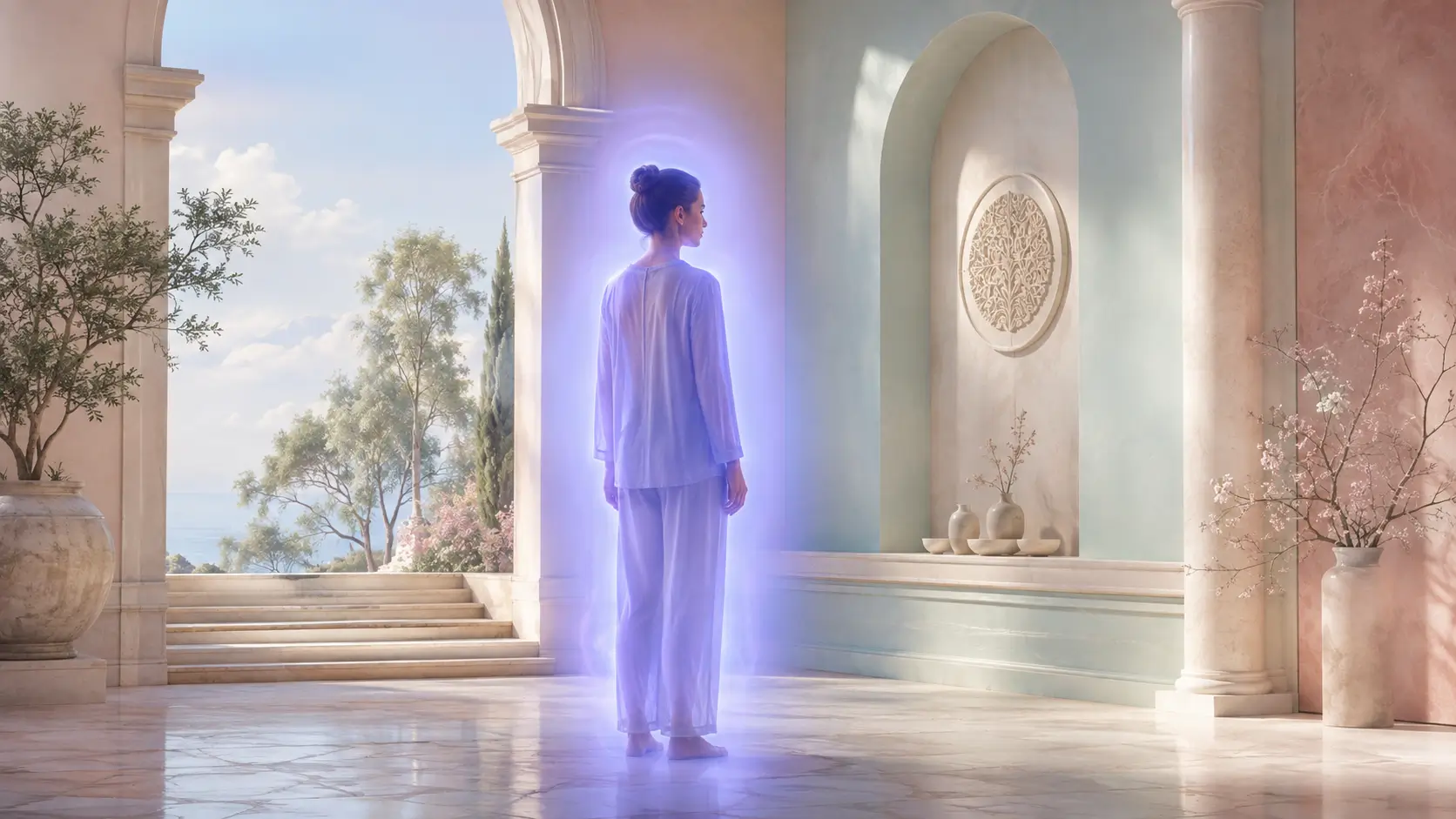
You sit down for an aura reading and, a few minutes later, someone tells you your aura is blue. Maybe they saw it directly. Maybe you stepped in front of an aura camera and walked away holding an aura photo of yourself surrounded by an electric halo. The next question is: what does blue actually mean?
Aura has become one of those spiritual words everybody recognizes and almost nobody defines the same way. Some treat aura colors like a cosmic personality type, as if you were issued one at birth and expected to keep it forever. Others use the word for the human energy field.
Then there are aura readers, color charts, cameras, cleansing rituals, and enough online tests to confidently inform half the internet that they are purple. Underneath all that noise is something much more useful: a changing energetic reflection of your present state.
So before deciding what blue, red, green, or violet supposedly says about you, let's look at what an aura actually is, what its colors represent, what an aura reader is really reading, and why humans have spent more than a century trying to photograph the thing.
What Is an Aura, Really?
A human being has seven bodies. The first four (the physical, etheric, astral, and mental) are the ones directly involved in daily life. The aura is the energetic reflection produced by those four bodies together.
It is not another body floating around you, nor the entire human biofield. The causal, buddhic, and atmic layers serve different functions and do not form the aura. That single difference clears up most of the fluff.
Chakras and meridians work directly inside these first four bodies. Their condition affects them, and the aura reflects the result.
An aura is less like an extra shell attached to your skin and more like the visible energetic expression of how you are doing right now. And because your life changes, the aura changes with it.
Your Aura Doesn’t Have a Favorite Color
We love to slap a permanent label on things. Walk away from an aura reading, and the temptation is instant: blue marks you as an intuitive communicator, green turns you into a natural healer, and purple crowns you a mystic.
It's comforting and easy to hold onto. But think about real life for a second:
Do you feel the same when you're well-rested and inspired versus when you're running on three hours of sleep and facing mounting deadlines? Or when you're dealing with heavy conflict compared to when you're deeply relaxed or falling in love?
Your physical body, emotional state, and everyday mental loops shift constantly. And because the aura is simply the energetic output of those layers, it moves right along with them.
Your aura carries a dominant hue right now for a simple reason: it reflects your present vibration. But turning a temporary energetic snapshot into a permanent personality trait is like taking your temperature during a flu, seeing a fever, and deciding that 102°F is who you are as a person.
The aura doesn't define who you are. It shows where you're at.
Reading the Seven Colors
The standard lineup gives us seven main colors: red, orange, yellow, green, blue, indigo, and violet. But a vivid red signals something completely different than a dim one.
Color corresponds to specific vibrational frequencies. An aura follows that same logic: each hue marks a specific energetic range:
- Red sits closest to physical survival: force, instinct, sexuality, and being alive in a body.
- Orange channels that energy into creativity, emotional movement, attraction, curiosity, and appetite.
- Yellow brings stronger individuality, directed will, confidence, and the drive to turn intent into action.
- Green is at the center. Like the heart chakra, it bridges the denser physical forces below with the subtler ones above, anchoring balance, restoration, connection, compassion, and growth.
- Blue opens into expression, truth, clarity, communication, and the ability to give coherent form to what you feel inside.
- Indigo turns perception inward: intuition, pattern recognition, inner sight, and knowing something before the rational mind finishes assembling an explanation.
- Violet reflects spiritual orientation, expanded awareness, connection with Source, and a loosening of purely material identification.
None of these frequencies is inherently "better" than another. Try surviving a dangerous situation with nothing but transcendence and see how quickly red becomes useful.
We've Been Trying to Photograph It for a Century
For as long as people have talked about energy fields, someone has been trying to capture them with a lens.
By the early twentieth century, simply sensing the field was no longer enough. In 1911, London physician Walter Kilner published The Human Atmosphere, documenting differences in field width, shape, and density using specially prepared chemical screens.
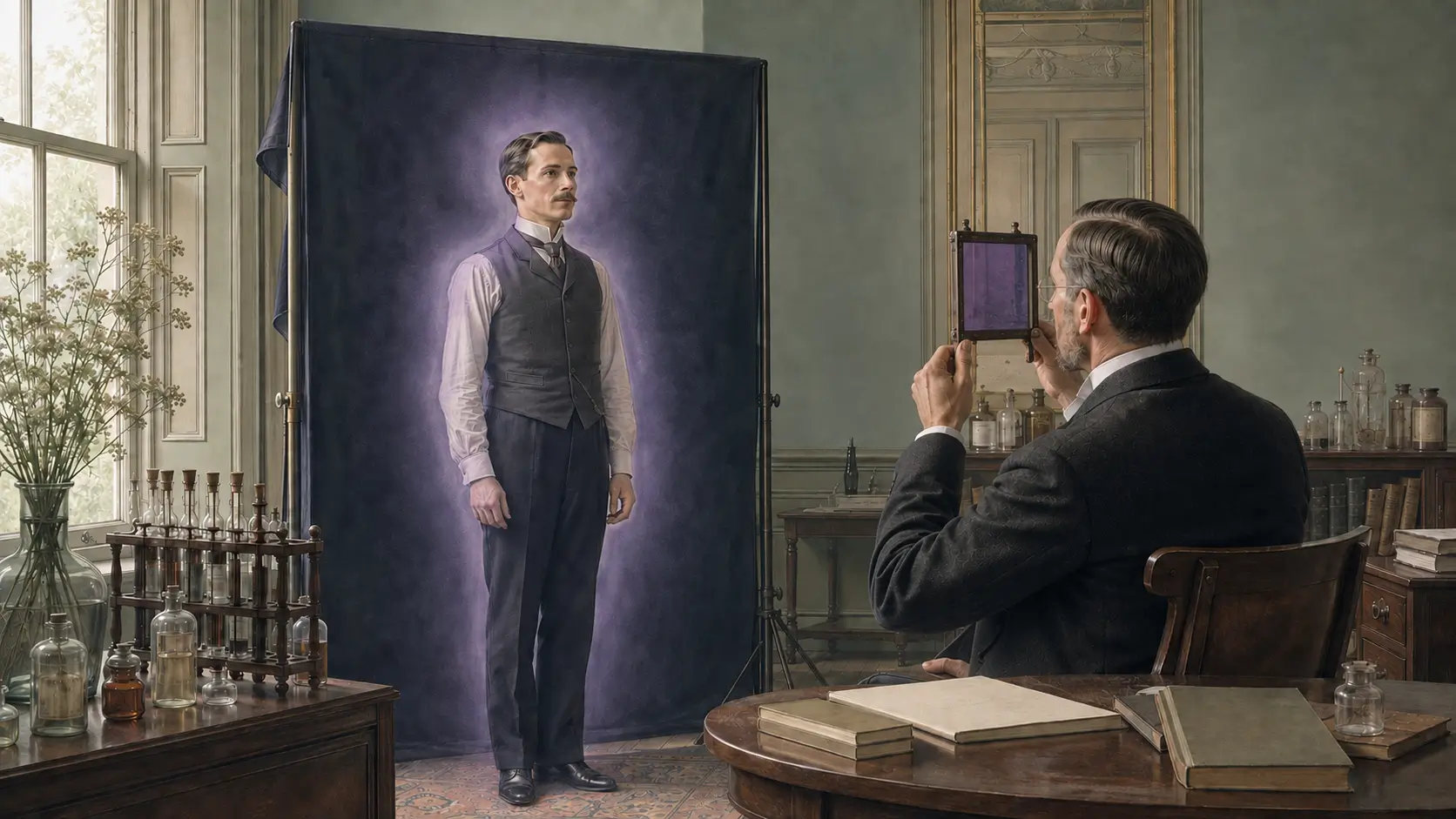
Kilner-inspired reconstruction of early aura observation using colored chemical screens.
Then electricity joined the story. In 1939, Russian electrical engineer Semyon Kirlian began experimenting with high-voltage discharge around objects. Fingers, leaves, and coins placed on photographic plates appeared surrounded by dramatic branching halos. Kirlian photography instantly became linked with the idea of capturing energy on film.
Modern aura photography works differently. Most systems do not capture raw field emissions directly. Instead, you place your hands on metal sensors that measure skin conductivity, temperature, and electrical resistance. Software translates those physical readings into colors and overlays them around a digital portrait.
Aura vs. The Energy Field
In casual conversation, people use "aura" and "energy field" interchangeably. Technically, they are not the same thing.
The aura is the reflection: the glow given off by your energetic body. Seeing a thin or dim aura only shows you the surface. A genuine practitioner uses that clue to look deeper into what is happening beneath it:
- Chakras: the energy centers regulating the intake and distribution of life force energy
- Meridians: the pathways routing that energy through the body
- Field Polarity: whether charges and directional flows are properly aligned
- Field Integrity: checking for leaks, tears, or areas of depletion
Reduced radiance or a loss of clarity shows that something is off. Checking the field shows you why.
What Disrupts the Field
Your energy is never static. It shifts with your internal state and reacts instantly to whatever touches you from the outside.
A reading captures what is actively affecting your balance in the moment:
- Physical Exhaustion: Illness, lack of sleep, and overworking erode your natural boundaries.
- Repressed Emotions: Unexpressed anger, deep grief, or fear leave dark patches and vulnerable spots.
- Psychic Attacks and Curses: Conscious malice, envy, or projections from others can tear open your space or leave persistent residue clinging to you.
- Cords and Attachments: Energetic ties or parasitic spirits that latch on and slowly drain your life force.
- Disturbed Spaces: Places soaked in old grief, past conflict, or stagnant spiritual presence that stick to you long after you leave.
An aura reading isn't a snapshot of who you are—it's a map of what is actively impacting your field.
You Don’t Clean the Reflection
When a reading reveals a disruption, the immediate impulse is "aura cleansing," as if the aura were a coat that occasionally needs washing.
Energy works in reverse: you do not clean the reflection, you fix what produces it.
Restoring vitality, releasing emotional buildup, or breaking a mental loop alters the energy field. The aura simply reflects those changes.
This is why generic remedies produce such inconsistent results. A salt bath or smoke can clear surface dust after a tough afternoon. But waving sage around won't dislodge a disruption anchored in your system for six months. Target the root, or you're just scrubbing a mirror expecting the face to change.
If Someone Read Your Aura Today
Not six months ago. Not the polished version you present to the world, or the idealized image in your head. Today.
What have the last few weeks actually done to you? How much vitality is left in the tank? What mood has been shaping your days, and what single thought has occupied your mind so relentlessly that it practically moved in and started paying rent?
Would your energy signature show balance, or reveal that you've been running on fumes while insisting everything is fine?
This is where the real value of an aura reading is. It was never meant to be a personality quiz, a spiritual badge, or a color chart for your ego. It's an honest report of your current state.
When you don't treat energy like a cosmic horoscope, the whole subject loses its fluff. You stop chasing quick fixes and start paying attention to how you actually live, rest, and set boundaries.
An aura reading doesn't care about spiritual titles or expensive crystals. It tells the unfiltered truth about what you're carrying right now, and gives you a chance to finally clear it.